

Tariffs haven't sparked a supply chain hiring boom. They've changed what companies need from the leaders they already have.
More than a year into the current tariff era, most large companies aren't adding supply chain headcount across the board. According to the KPMG 2026 Tariff Survey of 300 U.S. C-suite leaders, 44% invested in automation with little or no net job growth. Yet 31% hired specialized roles focused on tariff, trade, and compliance complexity, up from 22% just six months earlier.
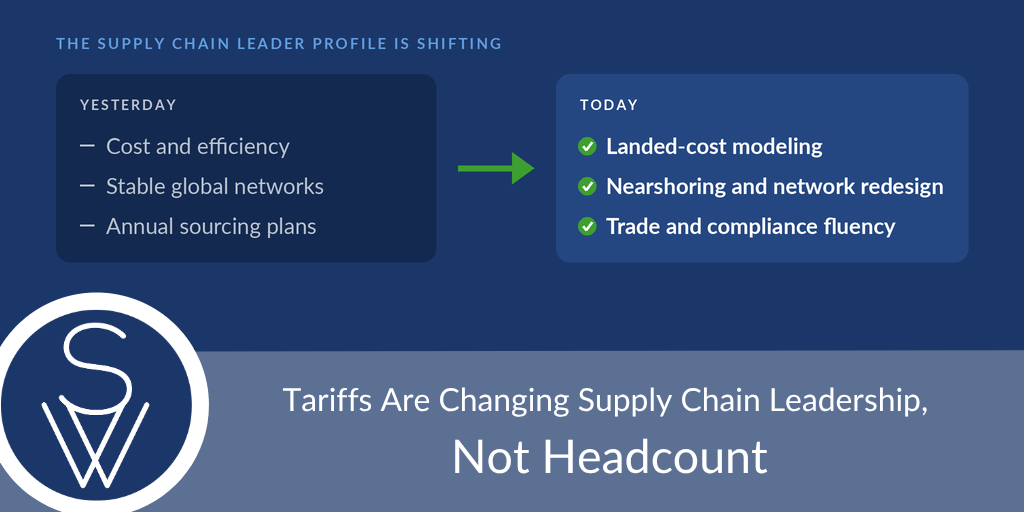
That's the real story. The supply chain leader who excelled at running a stable, low-cost global network is not automatically the leader who can redesign one under constant policy change. Companies are reshaping their supply chain leadership around a new set of skills, and the people who have them are in short supply.
The shift by the numbers
Tariffs have moved from a short-term disruption to a permanent planning factor, and the talent gap is showing up in supply chain first.
The pressure is nearly universal. In a McKinsey survey, 82% of supply chain leaders said new tariffs had directly affected their supply chains (via PullLogic). Concern is climbing, too: 72% of senior trade professionals now name tariff volatility their top regulatory worry, up from 41% a year ago.
Companies are moving from talk to action. Reshoring has shifted from early discussion to real plans. 26% of large companies are now formally planning or actively reshoring, up from just 10% six months earlier, according to the KPMG 2026 Tariff Survey. And it's a long game: 60% say fully reshoring would take one to three years.
The people to lead it are hard to find. Executives rank supply chain and logistics management among the toughest skills to hire in the U.S., with 40% naming it a top domestic talent gap (KPMG). Multi-year transformations need leaders who can see them through, and there aren't enough of them to go around.
The new supply chain leadership skill set
The leaders companies want now combine operational depth with trade, financial and technology fluency.
- Landed-cost modeling under shifting rules. A sourcing decision that made sense six months ago may not today. Companies want leaders who can model the true cost of a decision in real time, and who have rebuilt sourcing math mid-cycle when the rules changed, as SupplyChainBrain notes.
- Network redesign and nearshoring. Moving production closer to home sounds simple, but running a nearshore or reshored operation takes leaders who have physically re-engineered a supply network before.
- Trade and compliance fluency. Supply chain leaders increasingly need working knowledge of trade agreements, customs programs and cross-border regulation. In 2026, logistics and law are hard to separate.
- Financial acumen. Supply chain is now a margin conversation. SCOPE Recruiting puts it plainly: it is a financial function as much as an operational one.
- Scenario planning and visibility tools. Leaders who can use analytics, AI, and real-time visibility to plan for several possible policy outcomes, not just one forecast, have a clear edge.
- Proven crisis experience. A candidate who understands tariffs in theory is a different hire from one who has already navigated a disruption and made the hard calls before it hit.
Where the shift shows up
The chief supply chain officer is moving up and broadening out. More companies are combining supply chain with operations, procurement, or logistics under one senior leader. In 2026, Medtronic hired a chief operations and supply chain officer from Eaton, and Kraft Heinz named a global chief procurement and supply chain officer. These are enterprise roles with a seat at the strategy table.
Trade expertise is becoming its own leadership lane. Titles like head of tariff strategy, trade compliance leader and nearshoring or regional supply chain lead are moving up hiring lists, according to Pact & Partners. Some companies are also adding government affairs leaders to engage directly on trade policy.
Finance and supply chain are converging. Companies want supply chain leaders who think like CFOs, and finance partners who understand landed cost, pricing and sourcing tradeoffs. Pricing strategists and supply chain finance experts are in demand for the same reason.
Reshoring creates site-level leadership demand. As more companies move from evaluating reshoring to executing it, they need plant, operations, and regional leaders who can stand up new U.S. or nearshore operations.
What employers should do now?
The companies hiring well in this market are precise about what they need.
- Audit your current leadership against the new skill set. Who on your team has redesigned a network, modeled landed cost under changing rules, or managed cross-border compliance? Where are the gaps?
- Rewrite the job description. A supply chain role written five years ago likely emphasizes cost and efficiency. Today's version needs trade, finance, and scenario-planning expectations built in.
- Interview for experience, not theory. Ask candidates to walk through a specific disruption they navigated and the decisions they made, not how they would handle one hypothetically.
- Look beyond your industry. Strong trade and nearshoring experience often sits in adjacent sectors. A leader from automotive or industrial manufacturing may bring exactly the playbook a consumer or medtech company needs.
- Move quickly when you find the right person. Leaders with real tariff and reshoring experience are scarce, and the best are rarely job hunting. A slow process loses them.
The bottom line
Tariffs aren't creating more supply chain jobs. They're raising the bar for the ones that matter most. Whatever direction trade policy takes next, the companies with leaders who can adapt quickly will protect their margins and their customers.
At SkyWater Search, our supply chain and operations recruiters help organizations find leaders who have already navigated this kind of change. If your supply chain leadership needs to evolve with the market, let's talk.
Sources
- KPMG 2026 Tariff Survey
- KPMG Tariff Survey: One Year Later (PDF)
- PullLogic: How New Tariffs Are Reshaping Supply Chain Planning in 2026
- SupplyChainBrain: Five Nearshoring Skills to Hire for in 2026
- SCOPE Recruiting: Hiring Supply Chain Leaders for Nearshoring
- Pact & Partners: Tariffs, Trade Wars, and Executive Hiring in 2026
- MassDevice: Medtronic hires chief operations and supply chain officer
- CPO Rising: Procurement News, July 22, 2026